Saturday, October 24, 2015

Haze, Haze, Go Away, Don't Come Back Another Day

Howdy folks? It's been a hazy day in the South East Asia region, especially Malaysia, Indonesia and Singapore. This phenomenon is caused by the forest fire in Indonesia. It actually did hit above 200 for the Air Pollution Index at one time. We have to actually wear a protective mask to filter the smoke from entering our lungs.


At the same time, the sales of air purifier have also shot up tremendously due to this air quality problem. But the consumers need to know which air purifier to buy and which to avoid. I will share not on the specific air purifier that gives out a better air quality but I will share on which types of air purifier is energy efficient and provide long-term investment for the homes or office buildings.


How Does It Work?

Although they may seem like a new innovation, air purifiers have been around for more than 200 years. What started as protective masks for fireman, air purifiers have now evolved the ability to protect you and your family from airborne pollutants.
As allergies and asthma now affect more than 50 million of people around the world, the concern for safe indoor air quality has rapidly increased. Allergens like smoke, mold spores, pollen, bacteria, viruses, pet dander, and other pollutants damage your lungs and immune system. Unfortunately, most of these irritants cannot be seen by the naked eye. Air purifiers filter allergens and pollutants seen or unseen by the human eye. To remove these objects, air purifiers typically use filters, electrical attraction, or ozone.
Air filters utilize fine sieves that filter particles from circulating air. As air flows into the air purifier, the finer the sieve used, the smaller the particles it traps. The accepted benchmark for air filters has been set by the High Efficiency Particulate Air (HEPA) filters, which are guaranteed to trap 99.97% of airborne particles larger than 0.3 microns. Microns are the standard unit used for measuring air particles. Each micron is equivalent to 1/25,400 of an inch. The naked eye cannot see anything smaller than 10 microns, so pollutants like bacteria and viruses escape detection. Room air conditioner filters only capture particles 10.0 microns or larger. HEPA filters remove smaller allergens like dust, smoke, chemicals, asbestos, pollen, and pet dander.
The more times the air passes through the HEPA filter, the cleaner the air becomes. The room capacity of a HEPA air purifier will determine whether the air cleaner can handle your air purifying needs. 
In addition to the HEPA filter, there's an optional medical grade ultra-violet (UV) light system, used to quickly kill viruses, bacteria, and fungi upon entry into the air purifier. UV light also protects the HEPA filter from biological and viral contamination.
Electrical attraction is another technology utilized by air purifiers to trap particles. Three types of air cleaners work using electrical attraction: electrostatic precipitating cleaners, electret filters, and negative ion generators.
Electrostatic precipitating cleaners or electronic air purifiers draw particles in by fan and charge them with a series of high-voltage wires. Several plates (precipitating cells) carry the opposite electrical charge and attract the contaminants as they pass by the plates. Electronic air purifiers are perfect for individuals who don't want to worry about the costly replacements of HEPA filters. The downside to these units is that many create a nasty byproduct, ozone.
Electret filters in air purifiers use synthetic fibers that create static charges to attract particles. Electret filters are offered in a variety of types including plain, pleated, disposable or reusable. Depending on the type of filter you need, will determine how often the filter requires replacement.
Negative ion generators or ionic air purifiers use tiny, charged wires or needles to create gas molecules with negative charges or ions that adhere to the airborne particles and collect in the filter. However, many ions end up back in the air, sticking to furnishings and other surfaces that may be stained by them.
Ionic air purifiers only remove certain types of particles and aren't always effective against gases, chemicals, or odors. Some ionic air purifiers have been shown to re-circulate the same dirty particles that they draw in, making them much less effective than traditional air purifiers using HEPA filtration.

Types Of Air Purifier

It may come as no surprise to see that air purifiers come in all sorts of shapes, sizes and colors. What’s more important to notice, though, is not all air purifiers work the same. In fact, different types of air purifiers employ different technologies when cleansing the air you breathe.

It is vital to know and understand how each of these technologies work, so you can be sure to choose the right air purifier for your specific needs. Of course you will also need to know which air purifier is working efficiently with the energy consumption.

Clean Air Delivery Rate (CADR) is a measure of the amount of contaminant-free air delivered by the room air cleaner. When considering the purchase of an energy efficient room air cleaner, the comparison should not solely be based on CADR. The CADR of a specific air cleaner model is affected by a number of factors included the size of the model; larger units often have higher CADRs.


First, find the AHAM suggested room size noted prominently in the label. This suggested sizing should match the size of the room you are trying to clean. Next, compare CADR numbers from manufacturer to manufacturer and from air cleaner to air cleaner. Higher ratings for the dust, tobacco smoke and pollen CADR numbers indicate that the unit will filter the air faster than a unit with lower ratings. If the ratings are same from one unit to the other, then the air filtering performance is similar.

Return Of Investment

Room air purifiers - sometimes referred to as "room air cleaners" - are portable, electric appliances that remove fine particles, such as dust and pollen, from indoor air. A standard room air purifier, operating continuously, uses approximately 550 kWh per year in electricity. This is more than the energy used by some new refrigerators!
Energy efficient room air purifiers are 40% more energy-efficient than standard models, saving consumers about 225 kWh/year. These savings could add up to RM800 over its lifetime!

Friday, October 16, 2015

A Windy Season

Hello everybody and welcome back to my blog "Towards A Greener World". Hope you guys have a great time during the long weekends. I went for a short trip to a place called Mount KK and it was such a nice view. The people is nice, the food is fantastic and the weather is great. We even went to Kundasang (it's the closest town to Mount KK).


Imagine the outside temperature is below 20 degrees Celcius and I actually bathed cold water during the night. It was freezing and quite windy. When I was sitting down there relaxing and enjoying the skies, I can see the trees and leaves are moving vigorously due to the strong wind. Then the idea comes in: why didn't the locals install a wind turbine to harness the free energy?

Maybe they did not know about this recyclable energy and I believe some of the urban people also do not know about this. So I would like to share more on this energy source with you so that you can have some knowledge about it and maybe, just maybe, that you can install one on your roof to save on the energy bills.


How Does It Work?

So how do wind turbines make electricity? Simply stated, a wind turbine works the opposite of a fan. Instead of using electricity to make wind, like a fan, wind turbines use wind to make electricity. The wind turns the blades, which spin a shaft, which connects to a generator and makes electricity.


Wind is a form of solar energy and is a result of the uneven heating of the atmosphere by the sun, the irregularities of the earth's surface, and the rotation of the earth. Wind flow patterns and speeds vary greatly across the world and are modified by bodies of water, vegetation, and differences in terrain. Humans use this wind flow, or motion energy, for many purposes such as sailing, flying a kite, and even generating electricity.

The terms wind energy or wind power describe the process by which the wind is used to generate mechanical power or electricity. Wind turbines convert the kinetic energy in the wind into mechanical power. This mechanical power can be used for specific tasks (such as grinding grain or pumping water) or a generator can convert this mechanical power into electricity.


Types of Wind Turbine

Modern wind turbines fall into two basic groups: 
  1. the horizontal-axis variety, and 
  2. the vertical-axis design
Horizontal-axis wind turbines typically either have two or three blades. These three-bladed wind turbines are operated "upwind," with the blades facing into the wind. Wind turbines can be built on land or offshore in large bodies of water like oceans and lakes. 
Utility-scale turbines range in size from 100 kilowatts to as large as several megawatts. Larger wind turbines are more cost effective and are grouped together into wind farms, which provide bulk power to the electrical grid. 
Single small turbines, below 100 kilowatts, are used for homes, telecommunications dishes, or water pumping. Small turbines are sometimes used in connection with diesel generators, batteries, and photovoltaic systems. These systems are called hybrid wind systems and are typically used in remote, off-grid locations, where a connection to the utility grid is not available.

Return On Investment

The price of a home wind turbine could fetch from RM1075 minimum. However, do take note that a wind turbine is a relatively large device and it is not so suitable for urban or small-lot suburban homes. The economics of a wind system are determined by the average wind speed in the area, the availability of rebates or tax credits, and the cost of electricity. As a general rule-of-thumb, we recommend that you have at least a 10 mph average wind speed and be paying 10¢/kilowatt-hour or more for electricity. 

Will it help the environment if I install a wind turbine at my home? Wind turbines produce no pollution and by using wind power you will be offsetting pollution that would have been generated by your utility company. Over its nominal 30 year, life it will offset approximately 1.2 tons of air pollutants and 200 tons of greenhouse gases.

The return of your investment on wind turbine depends on your cost of electricity and average wind speed. The wind system will usually recoup its investment through utility savings within 6-30 years and after that the electricity it produces will be virtually free. Compared to purchasing utility power, a wind system can be a good investment because your money goes to increasing the value of your home rather than just paying for a service. Many people buy wind systems for their retirement because they are concerned about utility rate increases.

What To Consider When Buying?

What size would you need for your home? Homes typically use 1,000-2,000 kilowatt-hours of electricity per month. Depending upon the average wind speed in the area this will require a wind turbine rated in the range 5-15 kilowatts.

You do not need to take the wind measurement for a year before buying it. For residential systems the cost of taking wind measurements is not justified in most situations. Wind resource data published by the local authority is sufficient to predict performance. In a very hilly or mountainous areas, however, it may be prudent to take wind data before purchasing a system to ensure that your site in not in a sheltered area.
Are wind turbines reliable, and what about maintenance? The turbines have only 3 or 4 moving parts and do not require any regular maintenance. The turbines are designed to last 30-50 years or more and they operate completely automatically. Small wind turbines do make some noise, but not enough to be found objectionable by most people. They do not interfere with TV reception.

Pros & Cons

So how good or bad to install a wind turbine at your home? I have listed a few of them to help you decide on whether or not to install a wind turbine.


Wind Energy Pros
  • Wind energy is clean, and harnessing it does not produce any harmful by-products.
  • Wind is free and 100% renewable.
  • Turbines pay for themselves within a few years.
  • The power company pays you back if you produce extra electricity.
  • Tax incentives may be available from local or the federal government for those who install wind turbines.

Wind Energy Cons

  • Upfront costs are high.
  • You must have enough land to accommodate a turbine.
  • Not all geographical locations are suitable for wind turbines so have to check with your local wind speed averages.
  • Building codes may restrict turbine installation.
  • Wind turbines make noise and some people (possibly your neighbours) find them to be ugly.
  • Turbines typically operate at only 30 percent capacity (but to put that in perspective - solar panels operate at only 15 percent efficiency).
  • Blades have been known to kill birds.
  • Turbines can be damaged in lightning storms.

So as you can see, the renewable energy of wind is not for everyone. It still depends on few external and internal factors before installing it. But one thing for sure, as the electricity cost is going and with more introduction of tax rebate, this wind energy could be the next big thing for a smart home.

Saturday, October 10, 2015

Futuristic Automotive Industry

Hola, ¿cómo estas?
It's been a long time since I wrote my last blog post because was on a business trip. It was a fun and challenging experience, meeting with different people in a totally different culture. In case you are curious, I was in Yangon, Myanmar for the "Renewable Energy Conference 2015". It's a networking event that invites industry professionals that aims to build a partnership networking through face-to-face meetings and open discussions to build and further strengthen guests' networks.

While I was in Myanmar, I did saw some electrical cars that not only looks impressive on the outside but on the inside as well. The interior design looks sophisticated and it is comfortable while driving it. I checked on the Internet and it's truly an energy efficient hardware that's worth sharing with the masses.


How To Define An Energy Efficient Vehicle?

The car which has been with us since the 19th Century, has evolved tremendously over the decades. The year 1886 is regarded as the birth year of the modern car. In that year, German inventor, Karl Benz built the Benz Patent-Motorwagen. It had been through many histories, wars and technologies era. We have seen the emerging of many brands such as Toyota, Honda, Ferrari, and many more.


So how do we define an energy efficient car or vehicle? The answer is in the term called Fuel Efficiency. Fuel efficiency is a form of thermal efficiency, meaning the efficiency of a process that converts chemical potential energy contained in a carrier fuel into kinetic energy or work. Overall fuel efficiency may vary per device, which in turn may vary per application fuel efficiency, especially fossil fuel power plants or industries dealing with combustion, such as ammonia production during the Haber process.

In the context of transport, fuel economy is the energy efficiency of a particular vehicle, given as a ratio of distance traveled per unit of fuel consumed. Fuel economy is expressed in miles per gallon (mpg) in the USA and usually also in the UK (imperial gallon). There is sometimes confusion as the imperial gallon is 20% larger than the US gallon so that mpg values are not directly comparable. In countries using the metric system, fuel economy is stated in kilometres per litre (km/L) in the Netherlands, Denmark and in several Latin American or Asian countries such as India, Japan, South Korea, or as the reciprocal ratio, "fuel consumption" in liters per 100 kilometers (L/100 km) in much of Europe, Canada, New Zealand and Australia. Litres per mil are used in Norway and Sweden.


Fuel consumption is a more accurate measure of a vehicle’s performance because it is a linear relationship while fuel economy leads to distortions in efficiency improvements. Weight-specific efficiency (efficiency per unit weight) may be stated for freight, and passenger-specific efficiency (vehicle efficiency per passenger).

Fuel efficiency is dependent on many parameters of a vehicle, including its engine parameters, aerodynamic drag, weight, and rolling resistance. There have been advances in all areas of vehicle design in recent decades.

Hybrid vehicles use two or more power sources for propulsion. In many designs, a small combustion engine is combined with electric motors. Kinetic energy which would otherwise be lost to heat during braking is recaptured as electrical power to improve fuel efficiency. Engines automatically shut off when vehicles come to a stop and start again when the accelerator is pressed preventing wasted energy from idling.


Design

Cars are the primary mode of transport with most households having at least one. The current generation of cars emit greenhouse gases, which contribute to climate change. For every litre of petrol used in a motor vehicle, 2.3 kilograms of carbon dioxide (CO2) is released from the exhaust. The new breed of efficient cars and hybrids are increasing fuel efficiency by significant margins and with electric cars emerging onto the market, we have cars with zero net carbon emissions.

As one of the major investments for most families, car efficiency also means lower running costs, better insurance rates and even green loans. The efficiency of the vehicle (design, engine, weight, etc) determines the fuel consumption and the amount of greenhouse gases and airborne pollution released per kilometre, so there are many factors to consider when aiming to reduce the emissions you create. Here we shall take a look into two types of energy efficient car: Hybrid and Electrical

Hybrid - A vehicle is a hybrid if it utilizes more than one form of onboard energy to achieve propulsion. In practice, that means a hybrid will have a traditional internal-combustion engine and a fuel tank, as well as one or more electric motors and a battery pack. Hybrid cars are sometimes mistakenly confused with electric vehicles. Hybrids are most often gasoline-burning machines that utilize their electric bits to collect and reuse energy that normally goes to waste in standard cars. Theoretically, diesel-electric hybrids would be even more fuel-efficient, but hybrid systems and diesel engines both represent extra cost. So far, installing both in the same vehicle has proven to be prohibitively expensive.

Electric - also known as electric vehicle or EV, it uses energy stored in its rechargeable batteries, which are recharged by common household electricity. An electric car is powered exclusively by electricity. Historically, EVs have not been widely adopted because of limited driving range before needing to be recharged, long recharging times, and a lack of commitment by automakers to produce and market electric cars that have all the creature comforts of gas-powered cars. That has changed. As battery technology improved, simultaneously increasing energy storage and reducing cost, major automakers introduced a new generation of electric cars.


The Good, The Bad & The Not-So Ugly

With all the technology that is getting improved by the seconds, we all know that they bring more benefits than harm to the environment and living beings. However, we still need to know what is the upside and downside of using an energy efficient vehicle and it can be depicted  in the table below:


Prices vs Saving

Who doesn’t want clean air, clean water, a comfortable climate and a healthy environment for today and for future generations? Although most folks agree that hybrid and electric cars contribute to all of these society blessings, if they also save us money, they’ll grab a bigger share of the market.


Each person’s green car payback will be different. The comparisons are based on an average of 15,000 miles (1 mile = 1.6 km) driven annually, with 45 percent of that on highways and 55 percent within cities. If you drive more than that in the city, you could stand to save a ton of dough by driving a hybrid or all-electric car. Stop-and-go driving and relatively slower speeds require less energy from the cars’ batteries, maximizing the already stellar energy efficiency of electric drive.

If you drive more than 15,000 miles a year (that’s about 1,250 monthly, 312 weekly or 45 daily), you’ll definitely break even sooner. Gas prices are volatile and it’s difficult to predict their roller coaster rides. But there can be no disputing that the faster gas prices rise and the higher they go, the more you’ll save. Below is a simple worksheet devised to help you calculate your own potential payback period with whichever vehicles you’d like to consider and whatever gas price you want to input. (See How to Calculate Your Own Green Car Payback). The calculations and worksheet consider only prices and gas mileage, but you should also look at the cost or savings associated with insurance, maintenance and local incentives.


The Verdict 

Saving money doesn’t have to be the only determining factor when it’s time to buy a new car. People consider comfort, safety, performance, capacity, reliability, resale value, style, color and even whether a car has an iPhone dock. The bottom line is how well does a particular vehicle meet your particular needs and desires? The decision comes down to cost versus value: How much are you willing to pay for the features you want to get? What about the early adopters of the personal computer, Palm Pilot or iPad? They probably hoped those devices would serve their needs, but we’ll bet they didn’t expect those gadgets to pay for themselves. Many consumers simply enjoy the ability to invest in technologies they value.

Greener cars have been proven to be well made, durable and long-lasting and to save their owners thousands of dollars. Depending on the price of gas and what you want or need out of a good set of wheels, you may have to wait a few or even many years to realize your savings. How long will you have to wait? When it comes to green car payback, it all depends. But as they say: Patience is a virtue.

Friday, September 25, 2015

Nothing Beats A TV Time

Everyday there is a time where all the family members and friends would gather around at the living room and spend the quality time together in front of the magic box. These tradition has been around since the invention of the magic box called television.

So what is television? If you check on the dictionary, it says "a system for transmitting visual images and sound that are reproduced on screens, chiefly used to broadcast programs for entertainment, information, and education." So from the definition, we know that television has became from a luxury into a basic necessities in our daily life. 


Types of Television

There are so many televisions that had been invented to suit the lifestyle of many different races and classes. Buying a TV can be frustrating if you’re not quite sure what you are looking at. So we shall focus on the 5 types of television.

CRT - Cathode Ray Tube is the old style ‘chunky TV’ (and monitor).  The reason it’s so bulky is because the box has to house a screen and a projector gun. An image is created by firing electrons through this ‘gun’ onto a screen, exciting the particles on it. These TV formats have been on the fall since the early 2000’s with the introduction of far smaller LCD screens.


LCD - LCD’s are thin displays, normally used in laptop computers and TV screens. The term ‘LCD’ Stands for ‘Liquid Crystal Display’. A liquid crystal display is a special flat panel that can block light, or allow it to pass. The panel is made up of segments with each block filled with liquid crystals. The colour and transparency of these blocks can be changed by increasing or reducing the electrical current. LCD crystals do not produce their own light, so an external light source like a florescent bulb is needed to create an image.

LED Contrary to popular belief, LED TV’s are not a completely new format of TV- Instead they are simply an updated version of the previous LCD generation. LED use the same technology as an LCD TV, but instead of being illuminated by a florescent bulb from behind, they are lit by an array of LEDs (light emitting diodes). These are far more efficient and smaller in size, meaning the TV can be narrower. LED can be broken up into two further major categories Direct (Back-lit) LED and Edge-lit LED:
  1. Direct LED -These displays are backlit by an array of LEDs directly behind the screen. This enables focused lighting areas – meaning specific cells of brightness and darkness can be displayed more effectively.
  2. Edge-lit LED - As the name suggests have lights set around the television frame. Edge-lit models reflect light into the centre of the monitor, and are the thinnest, lightest models available. Since they have fewer lights in the centre of the screen.
LED is the most popular format of TV on the market now due to its cost, size and versatility, although it is not the highest quality image available.

PlasmaPlasma screens are made of 2 sheets of glass with a mixtures of gases stored between the layers. These gases are injected and sealed in plasma form during the manufacturing process, hence why we have the name ‘Plasma TV’. When charged with electricity, the gases react and cause illumination in the pixels across the screen. Plasma, is arguably superior to LCD & LED in terms of contrast and colour accuracy. However the format, due to costs, is restricted to larger screens sizes, usually 40-inch +.  In these larger screen sizes, buying the Plasma option tends to work out cheaper. It is also used in the super-sized 80-inch+ screens as the plasma screens are easier, and more cost effective, to produce over a larger size.

OLED - This is a massive leap forward in screen technology. Unlike its name suggests, OLED is nothing like LED. OLED stands for ‘Organic Light Emitting Diode’ and uses ‘organic’ materials like carbon to create light when supplied directly by an electric current. Unlike LED/LCD screens, an OLED TV doesn’t require a backlight to illuminate the set area. Without this restriction of an external light source, OLED screens can be super thin and crucially, flexible. As the individual areas can be lit up directly and not via an external backlight, the colours and contrasts are much better on OLED TV’s. On the whole, OLED is thinner, more flexible, faster at processing images, creates deeper colours and more crisp in contrast. It is, however, still very expensive and will not be seen on consumer TV’s at an ‘affordable price’ for at least another year.

Energy Efficient Television

ENERGY STAR certified televisions are on average, over 25 percent more energy efficient than conventional models, saving energy in all usage modes: sleep, idle, and on. The label can be found on everything from standard TVs to large screen TVs with the latest features like 3D and internet connectivity. Many models that earn the ENERGY STAR incorporate LEDs, the latest in screen backlighting technology.

Saving energy with ENERGY STAR certified home entertainment products helps protect the climate. A home equipped with TVs, a Blu-Ray player, a compact audio system, a cordless telephone and a home-theatre-in-a-box that have earned the ENERGY STAR, can save nearly RM500 over the life of the products. If each TV, DVD player, and home theatre system purchased this year earned the ENERGY STAR, we would prevent nearly 2 billion pounds of greenhouse gas emissions every year, equal to the emissions from more than 175,000 cars.

Financial Cost

When buying a new TV, as with any other electrical appliance, find out how much energy it uses, check out sust-it.net, before you buy. Taking long term running costs into your buying equation, makes sense. Look for ‘Energy Efficiency’ labels and, when you get it home, don’t leave it on standby.
Research done by Sust-it, the energy efficiency site for electrical hardwares, shows that TVs are now, on average, sixty per cent more efficient than they were five years ago.
When plasma and LCD TVs first arrived in the shops, we were dazzled by their stunning picture quality and screen size, and overlooked the fact that, compared with most tube televisions, these beasts were energy guzzlers – something the salesman, wowing us with bright colours and a 42-inch screen, would neglect to mention. In 2006 a 42-inch Plasma could have cost you RM474 per year to run (at today’s prices), now thanks to public awareness and advances in technology, a similar model uses nearly six times less energy, produces 264.90 kg less carbon and costs only RM84 to run per year.
Sust-it used its extensive energy usage data to compare the running costs of 1,800 televisions and found that since October 2006 and July 2011, there has been a decrease in the average amount of energy flat screen TV’s are using, and, in addition, the decrease in stand-by consumption is nearly 100 per cent.  This is better news for the environment, as TVs account for around 6-8% of the global domestic electricity usage, and for the consumer by saving them money on electricity bills.
Consumers need to be wary of old energy hungry plasma models, which are still available and will be difficult to spot until new energy labels for TV’s become mandatory in December 2011, go for LED if possible.
Sharp, whose TVs top Sust-it’s efficiency charts, commented on the research saying “Sharp have made increasing energy efficiency a key part of its wider commitment to minimising the environmental impact of product life-cycles. Technological advances are made not only to improve picture quality, but also to reduce energy needed to power the screen.  For example, the added yellow sub-pixel in Sharp’s proprietary four colour Quattron LCD panels allows more light through, using less energy to produce a brighter, sharper picture. Where ten years ago, a 32-inch TV would have consumed nearly 300 kWh (kilowatt-hours) per year, the same size Sharp TV now requires 80% less energy when turned on, and an amazing 98% less in stand-by mode.  This is why so many of our TVs have already received the 5-star energy efficiency rating.”

Saturday, September 5, 2015

Energy Efficient Wall

Hola~buen día a todos
Such a hazy day in the ASEAN countries, especially Malaysia and Indonesia. We all know that this is due to the open burning and it's getting worse. Somehow I hope that the countries' leaders can all sit down together and think of a solution for this environmental problem. Just like some of my colleagues were complaining about how hot their homes could get during these hazy days or even have some smells, which is not healthy.

So while we were all talking about these problems, we discussed if there's any wall that could do more than just covering the house's parameter? Is there any walls that could actually prevent heats from forming in the home? That's the today's topic that we shall discuss in this blog post.

Wall Types

A wall is a structure that defines an area, carries a load, or provides shelter or security. There are many kinds of walls:
  • Defensive walls in fortification
  • Walls in buildings that form a fundamental part of the superstructure or separate interior sections, sometimes for fire safety
  • Retaining walls, which hold back earth, stone, or water
  • Walls that protect from oceans 
  • Permanent, solid fences
  • Border barriers between countries (sometimes)

The materials you use for the walls in your home will affect how your home looks (both inside and out), how it'll stand up to fires, wind and physical stress, and how energy efficient your home is as a whole. Not many people are aware of just how many different types of wall materials are available. 
Framing Materials - The different materials that can be used to create the frame or structure of a home will have a big impact on its strength, insulation and cost.

Internal Wall Materials - The materials used on the walls inside a home have to be safe, compatible with the lighting scheme, and easy to maintain and keep clean.

External Wall Materials - External walls need to be tough, but they also need to look good. 

Problems With Non-Efficient Walls

A non-efficient walls usually provide a bad insulation for the homes. Many buildings with these features experience higher than anticipated utility bills, elevated levels of moisture or indoor air pollutants, and premature deterioration caused by moisture accumulation in walls and roofs. There are some areas that need to be inspected to provide good insulation.

Air Leakage Pathways
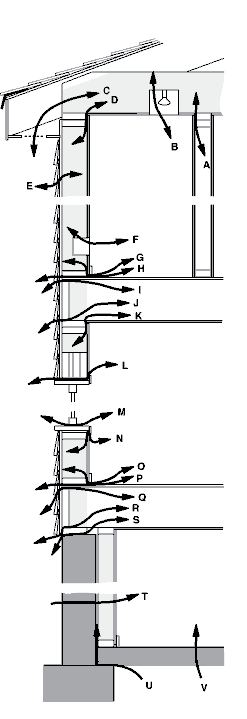
This illustration shows the cross-section of a building that many would consider to be energy-efficient: 2x6 studs, “housewrap” on the exterior, thick roof insulation, and insulated windows. As the arrows show, there can still be many places where there can be substantial air leakage. Some arrows indicate how air can flow from the interior to the exterior or from the exterior to the interior; other arrows indicate how exterior air blowing past the drywall can cause energy loss through conduction without entering or leaving the interior of the building; still other arrows indicate pathways for radon and other soil gases.
air leakage pathways
A – between wall top plates and drywall
B – through cracks in recessed fixtures
C – short circuits through attic insulation
D – between wall top plates and drywall
E – through gaps in siding and sheathing
F – through holes in electrical boxes
G – between bottom plate and drywall
H – between bottom plate and subfloor
I – between rim joist and subfloor
J – between rim joist and top plate
K – between top plates and drywall
L – around window and door jambs
M – leaky windows and doors
N – between window framing and drywall
O – between bottom plate and drywall
P – between bottom plate and subfloor
Q – between rim joist and subfloor
R – between rim joist and sill plate
S – between sill plate and foundation wall
T – through cracks in foundation wall
U – between floor and foundation wall
V – through cracks in floor slab

Heat Conduction Pathways
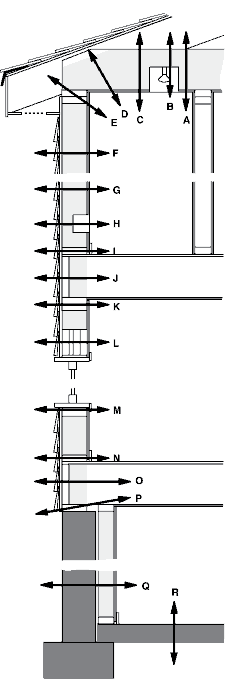
This illustration shows the cross-section of a building that many would consider to be energy-efficient: 2x6 studs, “housewrap” on the exterior, thick roof insulation, and insulated windows. As the arrows show, there can still be many places where substantial heat loss can occur through conduction.

heat conduction pathwaysA – uninsulated joists
B – minimal insulation above fixtures
C – insufficient ceiling insulation
D – insufficient insulation at corners
E – uninsulated double top plates
F – uninsulated wall studs
G – poorly fitted insulation
H – uninsulated electrical boxes
I – uninsulated bottom plate
J – inadequately insulated rim joist
K – uninsulated double top plates
L – uninsulated window header
M – improperly insulated window gaps
N – uninsulated bottom plate
O – inadequate rim joist insulation
P – uninsulated sill plate
Q – inadequate wall insulation
R – uninsulated slab


Moisture Transmission Pathways
There are four basic ways moisture moves in and out of buildings: it can flow as liquid water (since this is usually a consequence of poor flashing and drainage details, it is not covered here), it can can be sucked as liquid water by capillary forces acting in narrow spaces, it can be carried in as a vapor in air, and it can diffuse as a vapor through building materials.

moisture transmission pathwaysA – in air, between top plates and drywall
B – in air, through cracks in fixtures
C – by diffusion, upward in winter
D – by diffusion, downward in summer
E – in air, through ventilation inlets
F – by diffusion, outward in winter
G – by diffusion, inward in summer
H – by capillarity, through siding spaces
I – in air, through cracks in electrical boxes
J – in air, between bottom plate and drywall
K – in air, through insulation materials
L – in air, between drywall and top plates
M – in air, condensation on cold glass
N – in air, between framing and drywall
O – in air, between bottom plate and drywall
P – in air, through insulation materials
Q – in air, behind basement walls
R – by capillarity, from foundation to sill
S – by diffusion, through basement drywall
T – by diffusion and capillarity
U – by water flow, through cracks
V – by diffusion, from foundation to drywall
W – in air, between plate and drywall
X – in air, between bottom plate and slab
Y – by diffusion or capillarity through slab
Z – by diffusion, through footer and up wall


Energy Efficient Wall

Now, more than ever before, energy efficiency is one of the most important considerations when choosing building materials to use in homes and all forms of building construction.

As can be seen from the above diagram, the largest area of heat loss is through uninsulated walls. This has therefore been our main area of focus. The top priorities for energy efficient buildings is to be able to keep actual energy consumption low whilst decreasing the loss of heat from a building during cold days, and minimizing the entry of heat during the hot months.

Architects and builders are excited about Energy Efficient Brick because it is able to easily achieve these energy saving objectives. Most of a home’s energy consumption is spent in heating and cooling the interior, so one of the most important steps is to try and minimize these requirements.


The Green Energy Brick provides a continuous, unbroken layer around the building envelope and ensures airtight walls with the highest in energy rating performance. This allows for the purchase of much smaller sized heating and cooling equipment. With smaller equipment comes less initial outlay, and less ongoing costs.

Advances in modern technology have produced light weight, super energy efficient, yet stronger materials that can out perform many of the traditional construction materials. Let's review again the R rating comparisons below and you will again be impressed with the Energy Brick's performance!

Standard Clay bricks................................................................R0.078
Double brick with air space between...........................................R0.316
Weatherboards........................................................................R0.086
190mm hollow concrete blocks...................................................R0.19
Double 90mm hollow concrete blocks with air space in between.......R0.44
Cellular concrete with a density of 1,600kg/m3.............................R0.115
Cellular concrete with a density of 320kg/m3................................R1.19
Green Energy Bricks.................................................................R8+

*The higher the R-Value the better the thermal performance of the insulation. 


The unique Energy Brick, gives the look and feel of brick construction and yet vastly improves the energy rating of homes with their massive R8+ energy rating, and so provides the very best in energy performance, in any climate. Whether in the far reaches of Northern Australia, in the middle of the desert, or in the Southern parts of Asia, the Energy Brick meets the exacting requirements to minimize the use of artificial heating and cooling in a building, therefore saving you money!

An energy-efficient home is one that lowers energy bills and helps cut heating and cooling costs while enjoying more consistent temperatures in your home, all year round. Choosing the correct wall construction material makes all the difference regarding energy efficiency.

Wednesday, August 26, 2015

Bathing Time!

Annyeonghaseyo~bangbeob ida
Looks like the weather is changing drastically, especially in the Equator Line. We have a week of sudden torrential rain and suddenly it's a hot sunny day on the following week. Anyway, whenever we are soaked wet in the rain water or sweating under the dry hot sun, we'll surely look to our bathroom for a nice relaxing shower. So when it comes to using the bathroom, sometimes does it cross your mind that the water heater that you used is using a lot of electricity? So let's discuss on this issue on how to save this energy.

Design

People remodel more than 5 million bathrooms every year in the world. Sometimes this just means replacing lighting and plumbing fixtures. More extensive remodels involve building an addition or gutting and redesigning an existing bathroom. Regardless of the scale of the project, it is usually a good opportunity to save energy and water, improve comfort, and control moisture. Unfortunately an unwary remodeler may do the opposite. A poorly insulated bathroom can mean higher heating and cooling expenses, miserable bathers, or both. Moisture buildup can create a moldy room and damage the structure of the whole house. As remodelers work to make the space aesthetically pleasing, they should also make it a priority to create a comfortable, efficient, and dry room.

Ventilating the bathroom is absolutely vital in order to avoid a build up of moisture that can possibly damage the structural components of the home.  Ventilation also helps to prevent the formation of mould and mildew which can cause problems with allergies, as well as being unsightly.  The best way to ventilate the bathroom efficiently is to ensure that the bathroom has a window that is capable of good cross-ventilation.  There is no point in installing a small window, as it will not be able to handle the volumes of air required to keep the bathroom dry.  If installing a different window is not an option, then you can install an exhaust fan that vents to the outside of the home.  To prevent the fan being left on accidentally, it is possible to connect it to the light switch so that the fan turns on and off as the light does.

You may be surprised to learn that approximately 40% of all the water used in the home is used in the bathroom and the toilet.  So, if you wish to save water, the toilet, taps and shower are the main areas to look at in the bathroom. A dual flush toilet is much more efficient than a standard toilet as some are capable of using as little as 4.5 litres of water for full flush and 3 litres for a half flush.  If you don’t want to replace your toilet with a new one, there are gadgets available that you can fit to the toilet to reduce the amount of water being used.  These work by only allowing the toilet to flush when the button is physically held down.  Also consider using a rainwater tank for flushing the toilet or grey water from other areas of the home (such as the laundry). This water is perfectly adequate for toilet flushing and will save you from using precious mains water supplies.

Bathroom taps and shower heads are also two ways of saving water in the bathroom.  Water efficient taps should have a rating of 3-stars or more, or ideally 4-stars or higher.  If you are not replacing your taps, a water aerator will reduce the volume of water that comes from the tap significantly.  Standard shower heads can use as much as 20 litres of water per minute.  Simply by switching your shower head to one rated 3-stars or higher, you can reduce that amount to just 9 litres of water per minute without suffering a loss of water pressure.

It is also important to check your plumbing in the bathroom regularly, to ensure that there are no leaks anywhere – whether it is from the taps, the toilet or the pipes themselves.  Leaks are often so minor that they go undetected while wasting litres of water over what can be a very long period of time.

Hot water is the number one necessity in the bathroom, and the use of a solar hot water system will drastically reduce the amount of electricity or gas that you use.  Ensure that the system is placed as closely as possible to the three main hot water usage areas – the bathroom, kitchen and laundry.  If solar hot water is impractical in your residence for whatever reason, consider using a continuous flow hot water heater.  Continuous flow heaters only heat the water as it is being used, ensuring that the hot water never runs out, as well as ensuring that hot water is not sitting in a storage tank being constantly heated until it is used.  Whatever hot water system you use, make sure that the hot water pipes are insulated.

Heating is often a necessity in the bathroom, especially in the colder areas of Australia.  There are several heating options available such as underfloor heating, heating lights, and heating systems that run on gas or electricity.  While heating is a major user of energy, it is possible to minimize the amount used by using your heating appliances correctly.  Choose a heater that is the right size for your bathroom so that it does not have to overwork or underwork, and also only operate your heater as necessary.  Do not leave it on for hours just so that the bathroom is toasty warm when you enter. Only turn it on long enough to banish the chills and make the bathroom comfortable to use.  If you have a large family, it may be worth scheduling bathing times so that it is within the same block of time – meaning that the heater only has to be turned on once instead of multiple times throughout the day.

Gadgets

Of all the rooms in your house, the bathroom probably isn't top of the priority list for splashing cash on gadgets, seeing as most of your time is probably spent elsewhere unless you are an avid bubble bath fan.

But that's not to say the bathroom doesn't have its fair share of exciting gadgets and in fact, it has just as much potential to be as smart as the rest of your home. There are plenty of devices available now that can turn your bathroom into a clever one.

Showerhead - The Kohler Moxie Showerhead aims to make singing in the shower even more tempting with its built-in wireless speaker that connects to your devices using Bluetooth. There are a number of options to get this in your life, including either buying the Moxie with or without a wall arm, with a large showerhead or just the wireless speaker on its own. The speaker will work with your Bluetooth-connected device up to 32 feet away and it will pop out of the showerhead. There is a built-in rechargeable battery that will give you around seven hours playing time and the speaker itself comes in five colour options so you can even add a bit of style to the bathroom while you're at it.


Smart Body Analyzer Scale The Withings Smart Body Analyser Wi-Fi Scales do exactly what their name suggests and more. They will give you an accurate weight recording, along with body fat measurements, Body Mass Index (BMI), heart rate readings and information on air quality and the day's weather. The scales feature automatic user recognition for up to eight users so they know who they are weighing and they will also help you position yourself properly for the most accurate weigh in with the Position Control function. The Health Mate app will let you set weight goals and it will break them down into achievable targets, plus there are also a number of partners, such as MyFitnessPal so you'll find the scales are compatible with some of your favourite fitness apps too, allowing for easy integration.

Crosswater Digital Duo - The Crosswater Digital Duo is a two-way control system that allows you to switch between your shower or your bath easily. Apart from looking good, the Duo offers control of the temperature and flow for the perfect shower, or temperature and depth of your perfect bath at the touch of a button.There is built-in memory that will store individual settings for up to three people and the Duo is compatible with an iOS app that will allow you control your bath and shower from anywhere in the home on a wireless network. It means you can get the shower warmed up from the comfort of your bed before you step in, or you can turn it on as you come home from a run for example. There is also a wired remote control available that operates your bath or shower up to six metres away so you can put it on the bedroom wall by the light switch for your ensuite bathroom for example.

Cyber Mirror - The Tech2O Cyber Mirror doesn't come cheap, but isn't just a mirror. It's a mirror, TV and internet portal in one with an IP63 rating meaning it is safe to use in the bathroom. It has a 32-inch Full HD 1080p LED touchscreen display, Windows 8 software, an Intel Core i3 processor and there is Wi-Fi functionality so this mirror isn't your average piece of glass that shows you how bad you look in the morning. Freeview is also built-in, as are two 10-watt speakers so bubble bath time can become catching up on your favourite soap time. You can also use it to flick through emails or apps such as Facebook, as well as do your hair, check your make-up (wearing dependant) and listen to music. In terms of specifications, there are a number of inputs including three HDMI and three USB ports so if you want to use Chromecast with it to watch a film or series from Netflix, this shouldn't be a problem and you can even mount it as portrait or landscape. The Tech2O Cyber Mirror measures 1300 x 700 x 98.5mm and weighs 76kg so make sure your wall is strong enough to hold it or you might end up with seven years bad luck coming your way. 

Smart Toilet - The Kohler Numi toilet proves that almost anything can be gadgetry when you have some spare cash, even toilets. First and foremost the Numi is of course a product that allows you to pee into it but don't make the mistake of thinking that's its sole purpose. It does everything for you, except the physically peeing part. This toilet will automatically raise and close the seat, warm your bum up and even warm your toes. There is a self-cleaning bidet that has adjustable water temperature and pressure controls, plus there is also ambient lighting in seven colours. A built-in speaker system that connects to a remote docking station, a touchscreen and a touch panel remote so you can pick your preferences are also onboard. The Numi also has a Bluetooth receiver so you can stream music from your mobile, an SD card slot for personalised welcome messages or custom playlists and a USB port for software updates.

Waterpebble - The Waterpebble is for those of you who want to become more eco-conscious or simply save some money on your water bill. It has been designed to take the effort out of saving water and the pebble-shaped device will monitor water going down the plug hole, memorise your first shower and use it as a benchmark. Each following shower you have, the Waterpebble will indicate when to finish showering by using a series of three lights - red, orange and green - with green meaning start, orange telling you the half way point and red letting you know it is time to stop.The idea is that your water usage is reduced a little each time you shower, helping you save water without having to think about it too much. It can also be reset at any time if you decide the first shower you took was too short for example.

Return Of Investment

Home owners need to ask themselves a few fundamental questions before deciding if remodeling the bathroom is a good idea. The most important question is whether you are going to get your money back if you decide to sell the home in the future. When remodeling a bathroom, it's important for homeowners to have a good idea of what your improvements are worth. This helps you invest your money wisely.


Most home owners can't afford to waste money on pet projects that put a strain on your finances, so home owners must choose carefully when deciding on a remodeling project. Most professionals in the real estate field recommend choosing a project that yields a hefty return. Bathrooms are a great remodeling choice. When home buyers look at a home, they always ask about the bathrooms. For home owners, a bathroom remodel is pricey, but it's a safe bet that is very likely to be profitable. On average, bathroom remodeling projects yield a 60% return on investment. If the home owner is smart about their remodeling project, they increase the profitability of the remodel even more. A home owner might consider the following upgrades for their bathroom:
  • Multiple sinks
  • Glass showers
  • Good lighting
  • Shower seating
  • Extra storage
  • Floating vanities
An upgraded bathroom is welcoming and warm, which is appealing to home buyers who look for comfort and style when searching for a new home. It's important for home owners to pick upgrades that make use of neutral colours and finishes without following ultra-trendy designs. This ensures that the bathroom doesn't look old and used in a couple of years. Home owners should always consider increasing the size of the bathroom if possible; most home buyers prefer a home that has big bathrooms. It's easy to expand the size of a bathroom during a remodel or change certain features to make the bathroom feel bigger. For example, you might replace an over-sized, rarely used tub with a sleek glass shower to create more space in the room.
Many home owners make the mistake of choosing bathroom styles that aren't appealing to the public. When they do, they don't add much value to their home. It's always important to consider what a buyer is looking for in a bathroom to be sure of coming up with functional and stylish remodeling ideas. When remodeling a bathroom, home owners need to keep the design in harmony with the rest of the home. If a bathroom sticks out like a sore thumb, it spoils the appearance of the home, especially for potential buyers who may only take a quick tour of the house before deciding whether or not to make an offer. When a home owner is considering an upgrade that's going to be hard to sell in the future, you need to realize that home buyers won't be willing to pay for their eccentric designs. If they plan on staying in the home for a very long time, however, then it's acceptable to design according to your own preferences.
The great thing about bathroom remodeling jobs is that they don't need to be extensive. New paint, upgraded toilets and nice shower heads give homeowners the best bang for their buck. When a bathroom has floors and walls that are in good condition, simple strategic add-ons can skyrocket its value. When it comes to remodeling a home, popular trends change every five years. It's important for homeowners to choose timeless styles that don't lower their home's resale value in the future. Fortunately, bathrooms don't change that much; that's why they are one of the most profitable remodeling options out there.